About 66 minutes
Beechenbrook A Rhyme of the War — A Reader’s Guide
Fantasy Juvenile Worlds
14,957 recorded words. 4 minutes difference from this book's estimate.
View Gutenberg source #16480
Before opening With the Colors Songs of the American Service — Reading Notes, the edition data offers a quick orientation: 15,999 words, 1 hr 10 min estimated reading time, and 2 detected text sections.
The text analysis averages about 21.6 words per sentence, while the detected sections provide another way to judge how the source is divided.
Project Gutenberg metadata also associates the work with “World War, 1914-1918 -- Poetry,” connecting these edition facts with the source record’s subject description.
Explore this collection
These alternatives are selected using recorded categories and estimated reading time.
About 66 minutes
Fantasy Juvenile Worlds
14,957 recorded words. 4 minutes difference from this book's estimate.
View Gutenberg source #16480About 80 minutes
Fantasy Juvenile Worlds
18,301 recorded words. 10 minutes difference from this book's estimate.
View Gutenberg source #18287About 85 minutes
Fantasy Juvenile Worlds
19,327 recorded words. 15 minutes difference from this book's estimate.
View Gutenberg source #26797Search stored excerpts and compare books → Choose by your preferences →
Choices use stored catalog measurements. Estimates vary with reading speed. A shared category is a catalog label, not a claim that two books have the same argument or literary quality.
Search reads excerpt text stored with this catalog and links to its associated Gutenberg record. The connection is stored in the site database; this tool does not recheck that every excerpt is word-for-word identical to that external record. Excerpt search does not cover every chapter and does not verify historical publication dates.
Catalog snapshot checked: 2026-09-26. Coverage: 99 public books, 99 available source excerpts.
Calculated from edition completeness, EPUB availability, text structure and catalogue metadata. Not a user rating.
Total of 100 points, scaled to a 2.5-5.0 range. Editions with an empty description or a missing EPUB file are not scored.
Public-domain source text
The source text is kept in the dedicated reader, separate from this catalogue record and its commentary.
Appleton's With the Colors opens with a poem that insists the flag is not mere bunting but 'the soul of my country in sight,' a declaration that sets the collection's dual focus on patriotic sentiment and the everyday grit of service. The poems move between the voices of soldiers—a cook, a bugler, a hostler—and the quieter perspectives of those left behind, such as the mother in 'Little Mother' or the sandwich girl. This alternation between camp and home, between the collective 'we' and individual portraits, gives the book a documentary texture.
Appleton populates the first section with named or titled figures: Cookie Jim, Bugler Bill, Heinie the Hostler, Briggs of Base No. 8. Each poem adopts a distinct speaker, often in a rough, conversational idiom. In 'The Alien,' the speaker notes that 'the red and the blue and the white' are not just colors but something 'heaps better and finer.' The diction is deliberately unpolished—'half-baked patriots,' 'criticisin' chaps'—matching the persona of a plainspoken serviceman. This technique extends to the use of dialect and occupational slang, as in 'The 'Skeeter Fleet' or 'The Penguin Driver,' where the title itself hints at a specialized, slightly absurd job. The effect is a gallery of types rather than individuals, each defined by a single role or attitude.
The collection repeatedly shifts scenes from the front to domestic settings, often within a single poem. 'Her Johnny' imagines a woman at home reading a letter, while 'The First Fleet' describes ships departing. In 'Behind the Lines,' the speaker contrasts the soldier's experience with the civilian's ignorance. The second section, 'In Other Keys,' moves entirely away from war, offering love lyrics, nature poems, and humorous sketches—'The Bold Lover,' 'The Dog Confesses,' 'Br'er Rabbit in de Bresh Pile.' This structural pivot suggests that the war context is a frame rather than the sole subject. The romantic poems, such as 'We Rode at Night,' use a different, more lyrical register: 'We rode at night, and the cut-steel stars / Daggered the black of the quiet sky.' The juxtaposition of martial and pastoral imagery recurs throughout.
Certain images thread through both sections. The flag appears not only in the opening poem but also in 'Loyalty' and 'An American Creed,' where it is described as 'something that represents freedom.' Dawn and dusk recur as moments of transition: 'The radiant dawn flows up the empty sky' in 'Unfinished,' and later 'at the edge of dusk my love for you / Would speak.' The motif of incompleteness—unfinished morning, unfinished song, unfinished love—ties the war poems to the romantic ones. In 'Paid in Advance,' a day in spring is earned by 'gloomy days' endured with 'a shrug and a smile,' a logic of compensation that echoes the soldier's sacrifice. The physical scars of war appear obliquely: in 'We Rode at Night,' the speaker notes 'the scar is still there / On the brave little hand,' a mark that outlasts the passion.
Appleton employs a range of metrical patterns, from the loose iambic tetrameter of 'The Colors' to the more regular ballad stanzas of 'We Rode at Night.' The poems often use couplets or alternating rhymes, but the line lengths vary: short, punchy lines in 'Beans' contrast with the longer, more meditative lines of 'Unfinished.' The collection also includes dialect poems like 'Br'er Rabbit in de Bresh Pile,' which adopts a Southern African American vernacular, and 'The Small Boy Explains,' which mimics a child's voice. This variety in form and register suggests an attempt to capture the diversity of American speech. The second section's shift to more conventional lyric forms—sonnets, quatrains—further distinguishes the home-front poems from the rougher service verses.
Readers approaching With the Colors will find a collection that resists easy categorization: part war poetry, part character sketch, part love lyric. The poems reward attention to their shifting speakers and the recurring motifs that link the two sections. Appleton's use of colloquial diction and varied verse forms gives the book a documentary quality, even as the romantic poems in 'In Other Keys' offer a counterpoint. The collection is best read as a series of snapshots rather than a unified narrative, each poem contributing to a mosaic of American voices in 1917.
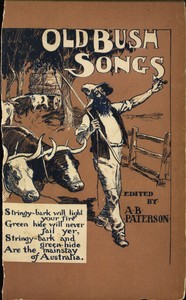
That rainy afternoon, Appleton’s soldier voices lingered—homesick, wry, tender—until a footnote mentioned Australian diggers singing their own rough verses. I put the book down, curious, and found The Old Bush Songs — Themes and Context beside it. Same yearning, different dust. The rain kept falling, and I just listened.
Use these questions to collect your thoughts before moving on.