About 102 minutes
Genesis A — Text and Context
Fantasy Juvenile Worlds
23,245 recorded words. 7 minutes difference from this book's estimate.
View Gutenberg source #15612
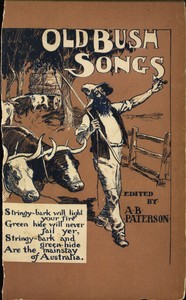
This digital edition of The Old Bush Songs — Themes and Context is described by source-level measurements including 24,936 words, 1 hr 49 min estimated reading time, and 3 detected text sections.
The text analysis averages about 21.5 words per sentence, while the detected sections provide another way to judge how the source is divided.
Project Gutenberg metadata also associates the work with “Australian poetry,” connecting these edition facts with the source record’s subject description.
Explore this collection
These alternatives are selected using recorded categories and estimated reading time.
About 102 minutes
Fantasy Juvenile Worlds
23,245 recorded words. 7 minutes difference from this book's estimate.
View Gutenberg source #15612About 118 minutes
Fantasy Juvenile Worlds
27,067 recorded words. 9 minutes difference from this book's estimate.
View Gutenberg source #13535About 93 minutes
Fantasy Juvenile Worlds
21,207 recorded words. 16 minutes difference from this book's estimate.
View Gutenberg source #12696Search stored excerpts and compare books → Choose by your preferences →
Choices use stored catalog measurements. Estimates vary with reading speed. A shared category is a catalog label, not a claim that two books have the same argument or literary quality.
Search reads excerpt text stored with this catalog and links to its associated Gutenberg record. The connection is stored in the site database; this tool does not recheck that every excerpt is word-for-word identical to that external record. Excerpt search does not cover every chapter and does not verify historical publication dates.
Catalog snapshot checked: 2026-09-26. Coverage: 99 public books, 99 available source excerpts.
Calculated from edition completeness, EPUB availability, text structure and catalogue metadata. Not a user rating.
Total of 100 points, scaled to a 2.5-5.0 range. Editions with an empty description or a missing EPUB file are not scored.
Public-domain source text
The source text is kept in the dedicated reader, separate from this catalogue record and its commentary.
Paterson’s preface frames the collection as a salvage operation: the songs were “composed and sung in the Bushranging, Digging, and Overlanding Days,” and the editor aimed to present them “as nearly as possible as it was sung.” The roughness is deliberate—no smoothing of metre or softening of language. The catalog subjects list “Australian poetry” and “Songs, English — Australia,” but the excerpts reveal a stronger connection to vernacular storytelling than to literary ambition. Many songs are anonymous, and Paterson notes that some “were begun by one man and finished or improved by another.” This collaborative, oral origin is visible in the repeated choruses and formulaic structures.
The songs in this collection rarely mention home or domestic affections, as Paterson himself observes. Instead, they focus on work: shearing, droving, digging, and mustering. In “The Murrumbidgee Shearers,” the chorus celebrates “the sound of the shears” and the “click of the blades.” The language is practical and direct, with terms like “bald-faced steer,” “greenhide fall,” and “bucking brumbie” anchoring the verses in specific tasks. The diggings appear in songs like “Bold Jack Donahoo,” where the bushranger’s exploits are recounted with a mix of admiration and caution. These are not polished ballads but working songs, meant to be sung around campfires or in shearing sheds.
Several songs treat death with a blend of sentiment and dark humor. In “The Dying Stockman,” the speaker asks to be buried “where the dingoes and crows can’t molest me, / In the shade where the coolibahs grow.” The stockman’s last request includes a cross carved with “stockwhip, and saddle.” “My Mate Bill” imagines heaven as a cattle station where Bill, a skilled stockman, might “yard ’em all in the Jasper Lake.” The poem questions whether an angelic existence suits a man who “could sit on a bucking brumbie / Like a nob in an easy chair.” These songs do not romanticize death; they reframe it in the familiar terms of bush labor.
The catalog subjects classify this as “Australian poetry” and “Songs, English — Australia,” but the excerpts resist easy categorization. Many songs are not strictly English in origin—some, like “Paddy Malone in Australia,” use Irish dialect and references. The “Two Aboriginal Songs” listed in the contents are not included in the excerpts, so their content remains unknown. Paterson’s preface acknowledges that the songs were “collected from all parts of Australia,” yet the excerpts show a strong bias toward the southeastern colonies: New South Wales, the Murrumbidgee, the Maranoa. The catalog does not capture the unevenness of the collection or the gaps in representation.
Readers should approach this collection as a historical document rather than a polished anthology. The songs are uneven in quality and authenticity, but their roughness is part of their value. Paterson’s editorial hand is light, preserving dialect, irregular metre, and local references. For those interested in the vernacular culture of 19th-century Australia, these songs offer a direct, unvarnished record—provided one reads with attention to what is included and what is left out.
I finished The Old Bush Songs and found myself thinking about how those rough-hewn verses carry a whole world of quiet endurance, the way a campfire song can hold loneliness and mateship at once. It reminded me of something similar in A Book of German Lyrics — Context and Discussion—how another people’s tunes hold their own kind of ache. Some lines just stay with you.
A brief reflection can help important ideas stay with you longer.