About 20 minutes
Abraham Lincoln: An Horatian Ode — A Closer Reading
Fantasy Juvenile Worlds
4,445 recorded words. 1 minutes difference from this book's estimate.
View Gutenberg source #18573
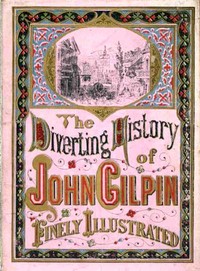
For The Diverting History of John Gilpin — Story, Setting & Ideas, the stored edition analysis reports 4,610 words, 21 min estimated reading time, and 1 detected text section.
The text analysis averages about 23.5 words per sentence, while the detected sections provide another way to judge how the source is divided.
Project Gutenberg metadata also associates the work with “English poetry,” connecting these edition facts with the source record’s subject description.
Explore this collection
These alternatives are selected using recorded categories and estimated reading time.
About 20 minutes
Fantasy Juvenile Worlds
4,445 recorded words. 1 minutes difference from this book's estimate.
View Gutenberg source #18573About 20 minutes
Fantasy Juvenile Worlds
4,442 recorded words. 1 minutes difference from this book's estimate.
View Gutenberg source #27727About 18 minutes
Fantasy Juvenile Worlds
4,090 recorded words. 3 minutes difference from this book's estimate.
View Gutenberg source #23614Search stored excerpts and compare books → Choose by your preferences →
Choices use stored catalog measurements. Estimates vary with reading speed. A shared category is a catalog label, not a claim that two books have the same argument or literary quality.
Search reads excerpt text stored with this catalog and links to its associated Gutenberg record. The connection is stored in the site database; this tool does not recheck that every excerpt is word-for-word identical to that external record. Excerpt search does not cover every chapter and does not verify historical publication dates.
Catalog snapshot checked: 2026-09-26. Coverage: 99 public books, 99 available source excerpts.
Calculated from edition completeness, EPUB availability, text structure and catalogue metadata. Not a user rating.
Total of 100 points, scaled to a 2.5-5.0 range. Editions with an empty description or a missing EPUB file are not scored.
Public-domain source text
The source text is kept in the dedicated reader, separate from this catalogue record and its commentary.
William Cowper's The Diverting History of John Gilpin opens with a linendraper of 'credit and renown' whose wife proposes a rare holiday after twenty years of marriage. The poem's brisk quatrains immediately establish a world of domestic negotiation: Mrs. Gilpin insists on bringing their own wine because 'that wine is dear,' and John Gilpin praises her 'frugal mind.' These small economic details anchor the ensuing farce in recognizable middle-class concerns, making the runaway horse and flying bottles feel less like fantasy than an exaggeration of everyday mishap.
Cowper writes in common meter—alternating lines of eight and six syllables—a form familiar from hymns and ballads. The regularity of the rhythm creates a steady, almost mechanical beat that contrasts with the growing disorder of the ride. When John Gilpin first mounts, the lines move slowly: 'Full slowly pacing o'er the stones, / With caution and good heed.' But as the horse breaks into a trot and then a gallop, the meter itself seems to accelerate, the short lines tumbling forward. Cowper reinforces the speed with internal rhymes and alliteration: 'The stones did rattle underneath, / As if Cheapside were mad.' The poem's structure—a series of four-line stanzas, each a self-contained unit of action—mirrors the jerky, episodic nature of the chase, with each stanza delivering a fresh mishap or reversal.
The comedy of John Gilpin depends on the collision between domestic order and uncontrollable motion. Mrs. Gilpin's careful preparations—the two stone bottles with 'curling ear[s],' the leathern belt, the long red cloak—are all meticulously described, only to become instruments of chaos. The bottles, hung on either side 'to make his balance true,' swing wildly as the horse gallops. The red cloak, 'well brush'd and neat,' flaps behind the fleeing rider. Cowper lingers on these objects because their ordinariness makes the disaster relatable. Even the initial plan—a chaise and pair for the family, John on horseback—is a practical arrangement that goes wrong when customers delay him. The poem's humor arises not from supernatural events but from the failure of sensible plans in the face of stubborn reality.
The surviving excerpt breaks off as John Gilpin's horse begins to gallop 'in spite of curb and rein,' leaving the outcome unknown. From the available text, we can observe that the narrator maintains a detached, almost reportorial tone, recording events without moral commentary. John Gilpin's own speech is limited to a few lines: 'So! fair and softly!' he cries, but 'John he cried in vain.' The wife, despite initiating the adventure, disappears after the departure. The poem's voice is that of a storyteller who finds the situation amusing but never mocks the protagonist directly. Without the full text, we cannot know whether the ride ends in disaster or recovery, but the title's word 'diverting' suggests the pleasure lies in the journey itself, not its destination.
Readers approaching The Diverting History of John Gilpin should attend to the interplay between the poem's formal restraint and its subject's escalating chaos. Cowper's choice of common meter, a rhythm associated with solemnity, heightens the absurdity of a linendraper clinging to a galloping horse. The poem rewards attention to its small, concrete details—the stone bottles, the red cloak, the chaise parked three doors off—which ground the farce in a recognizable world. The incomplete excerpt leaves the ride's conclusion unknown, but the poem's enduring appeal lies in its precise, good-humored observation of a plan unraveling.
That runaway horse always makes me think of my uncle, red-faced and stubborn, clinging to a frayed leash at our family picnic. The chaos felt familiar, a domestic farce spinning out. Later, reading The Rubaiyat of a Huffy Husband — A Closer Reading brought back that same warmth, the gentle laughter at life's small, inevitable disasters we all share.
A brief reflection can help important ideas stay with you longer.