About 24 minutes
A Defective Santa Claus — A Reader’s Guide
Adventure Picaresque Fiction
5,389 recorded words. 3 minutes difference from this book's estimate.
View Gutenberg source #20181
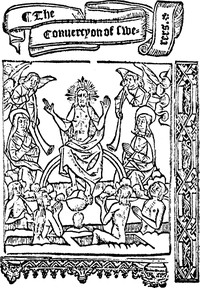
For The Conuercyon of swerers (The Conversion of Swearers) — Reading Notes, the stored edition analysis reports 6,023 words, 27 min estimated reading time, and 1 detected text section.
The text analysis averages about 38.4 words per sentence, while the detected sections provide another way to judge how the source is divided.
Project Gutenberg metadata also associates the work with “Poetry,” connecting these edition facts with the source record’s subject description.
Explore this collection
These alternatives are selected using recorded categories and estimated reading time.
About 24 minutes
Adventure Picaresque Fiction
5,389 recorded words. 3 minutes difference from this book's estimate.
View Gutenberg source #20181About 19 minutes
Adventure Picaresque Fiction
4,323 recorded words. 8 minutes difference from this book's estimate.
View Gutenberg source #22490About 15 minutes
Adventure Picaresque Fiction
3,225 recorded words. 12 minutes difference from this book's estimate.
View Gutenberg source #26874Search stored excerpts and compare books → Choose by your preferences →
Choices use stored catalog measurements. Estimates vary with reading speed. A shared category is a catalog label, not a claim that two books have the same argument or literary quality.
Search reads excerpt text stored with this catalog and links to its associated Gutenberg record. The connection is stored in the site database; this tool does not recheck that every excerpt is word-for-word identical to that external record. Excerpt search does not cover every chapter and does not verify historical publication dates.
Catalog snapshot checked: 2026-09-26. Coverage: 99 public books, 99 available source excerpts.
Calculated from edition completeness, EPUB availability, text structure and catalogue metadata. Not a user rating.
Total of 100 points, scaled to a 2.5-5.0 range. Editions with an empty description or a missing EPUB file are not scored.
Public-domain source text
The source text is kept in the dedicated reader, separate from this catalogue record and its commentary.
Stephen Hawes opens The Conuercyon of swerers by positioning his poem within a tradition of didactic writing, invoking the 'frutefull sentẽce & the noble werkes' of ancient clerks and poets who 'cloked in coloure' their truths. He singles out his 'good mayster Lydgate' as a model, then immediately contrasts his own youth and inexperience: 'I lytell or nought expert in poetrye / Remembrynge my youth so lyght and frayle.' This self-deprecating stance frames the poem as both a moral corrective and a personal exercise against idleness, which he calls 'the grete moder of synne.'
The work’s structure moves from a general defense of learning—'Amonge all thynges nothynge so prouffytable / As is scyence'—to a direct attack on swearers who 'god assayle / On euery syde his swete body to tere.' Hawes repeatedly uses the image of tearing Christ’s body, linking swearing to physical violence. The poem’s title, with its archaic spelling 'Conuercyon,' signals both conversion and a turning away from sin, though the surviving excerpts focus more on condemnation than on any narrative of reform.
Hawes establishes his authority by disclaiming it. He calls himself 'lytell or nought expert' and says his pen 'dothe quake to presume to endyte,' yet he presses on, driven by hope and the desire to 'deuoyde ydlenesse.' This rhetorical posture is conventional for medieval and early Tudor poets, but Hawes gives it a personal edge by linking his own idleness—'I with the same ryght gretely infecte'—to the sin he condemns. The poem thus becomes a kind of self-cure, as he writes 'to eschewe ydlenesse.' The opening stanzas also serve as a mini-ars poetica: Hawes praises 'scyence' (knowledge) as stable and profitable, unlike worldly riches which are 'often transmutable.' This defense of learning prepares the ground for the moral lesson to follow, suggesting that the poem itself is an act of intellectual and spiritual discipline.
The central image of the poem is the physical tearing of Christ’s body by swearers. Hawes writes that they 'god assayle / On euery syde his swete body to tere / With terryble othes as often as they swere.' The verb 'tere' (tear) is visceral, repeated to emphasize the violence of blasphemy. This is not a metaphorical wound but a literal rending, as if each oath is a claw. The poem’s structure reinforces this: the opening praise of learning gives way to a lament that shifts abruptly into accusation. The swearers are 'cruell,' and their oaths are 'terryble,' suggesting both fearfulness and terror. Hawes does not describe the swearers’ motives or social context; instead, he focuses on the act itself, making the body of Christ the central site of injury. This image recurs throughout the excerpts, tying the poem’s moral argument to a stark, physical emblem.
Alongside the imagery of tearing, Hawes introduces a counter-image of healing. He describes himself as 'Lykely to deye tyll grace by medecyne / Recured my sekenes my payne to abiecte.' Grace is figured as a physician who 'Commaundynge me by her hye power deuyne / To drawe this treatyse for to enlumyne / The reders therof by penytencyall pyte.' The poem itself becomes a medicinal text, intended to cure both the author and his readers. This medical metaphor extends the structure: the diagnosis is the tearing of Christ, the remedy is the poem’s penitential call. Hawes asks for pardon for his 'rudnesse' and submits to the reader’s 'benygnyte,' closing the frame he opened. The movement from sickness to cure mirrors the conversion promised in the title, though the excerpts do not show any swearer actually converting.
The colophon reveals that the poem was 'Enprynted at London, in Fletestrete, at the sygne of the Sonne, by Wynken de Worde' in 1509, the first year of Henry VIII’s reign. This places the work at a specific historical moment, when the new king’s court might have been a target for moral reform. Hawes identifies himself as 'groome of the chambre of our souerigne lorde Kyng Henry the seuenth,' a position that gave him access to the royal household. The poem’s attack on swearing may reflect courtly concerns, though the text itself does not specify an audience. The colophon also notes that the poem was 'made and compyled' by Hawes, suggesting both original composition and compilation of sources. The physical book, with its archaic spellings and abbreviations, reminds modern readers of the distance between Hawes’s world and our own, a distance that the poem’s vivid imagery partly bridges.
Readers approaching The Conuercyon of swerers should attend to its dual movement: the poet’s self-presentation as a reluctant, sinful writer and the urgent, physical language of blasphemy. The poem is short—just over 6,000 words—and its stanzas move quickly from praise of learning to lament to admonition. Hawes’s reliance on the image of tearing and the metaphor of medicine gives the work a coherence that transcends its occasional nature. The archaic spelling and typography of the original print may slow a modern reader, but the poem’s central concern—the power of words to harm or heal—remains immediate.
Lately I’ve been thinking about that 1509 poem, how the poet calls himself “lytell expert” and still sets about mending something. There’s a comfort in that—work done gently, without certitude. It reminds me of the quiet companionship found in Lyra Frivola — A Reader’s Guide, which feels less like a guide than an old friend’s margin notes, kept for no one in particular.
Use these questions to collect your thoughts before moving on.