About 66 minutes
Lyra Frivola — A Reader’s Guide
Adventure Picaresque Fiction
15,148 recorded words. 2 minutes difference from this book's estimate.
View Gutenberg source #17898
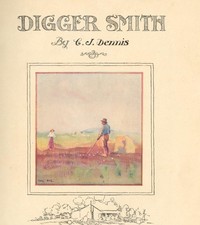
The catalog record for Digger Smith — Background and Themes provides practical reading context through 14,582 words, 1 hr 4 min estimated reading time, and 2 detected text sections.
The text analysis averages about 13.9 words per sentence, while the detected sections provide another way to judge how the source is divided.
Project Gutenberg metadata also associates the work with “Australian poetry,” connecting these edition facts with the source record’s subject description.
Explore this collection
These alternatives are selected using recorded categories and estimated reading time.
About 66 minutes
Adventure Picaresque Fiction
15,148 recorded words. 2 minutes difference from this book's estimate.
View Gutenberg source #17898About 51 minutes
Adventure Picaresque Fiction
11,646 recorded words. 13 minutes difference from this book's estimate.
View Gutenberg source #12664About 77 minutes
Adventure Picaresque Fiction
17,625 recorded words. 13 minutes difference from this book's estimate.
View Gutenberg source #16362Search stored excerpts and compare books → Choose by your preferences →
Choices use stored catalog measurements. Estimates vary with reading speed. A shared category is a catalog label, not a claim that two books have the same argument or literary quality.
Search reads excerpt text stored with this catalog and links to its associated Gutenberg record. The connection is stored in the site database; this tool does not recheck that every excerpt is word-for-word identical to that external record. Excerpt search does not cover every chapter and does not verify historical publication dates.
Catalog snapshot checked: 2026-09-26. Coverage: 99 public books, 99 available source excerpts.
Calculated from edition completeness, EPUB availability, text structure and catalogue metadata. Not a user rating.
Total of 100 points, scaled to a 2.5-5.0 range. Editions with an empty description or a missing EPUB file are not scored.
Public-domain source text
The source text is kept in the dedicated reader, separate from this catalogue record and its commentary.
C.J. Dennis's Digger Smith opens with a domestic scene that immediately establishes its narrative voice: the unnamed speaker, a farmer, recounts his wife Doreen's social rituals with a mixture of exasperation and affection. The poem's first lines—"Before the war," she sighs. "Before the war"—introduce a refrain that will echo through the work, marking a before-and-after divide that the speaker struggles to articulate. Dennis uses a colloquial Australian vernacular, with dropped consonants and compressed syntax, to create a speaker who is self-deprecating yet observant. The early sections are brisk and comic, detailing the speaker's discomfort with tea parties and his wife's "social 'abit." But the tone shifts as the poem moves toward the figure of Digger Smith himself, a returned soldier whose presence prompts the speaker to reflect on what war has changed and what remains unsaid.
The poem's language is its most distinctive feature. Dennis writes in a broad Australian dialect, rendering the speaker's voice through phonetic spelling: "I ain't averse—one more new word I've learned—/ Averse to tea, when tea is to be 'ad." This is not mere decoration; the dialect signals the speaker's class and his resistance to pretension. He is acutely aware of the gap between his own plain speech and the polite conversation expected at tea. When he says, "I 'aven't got no comp'ny voice," he is admitting a limitation that becomes central to the poem's theme: the difficulty of talking about war. The speaker can joke about bread-and-butter duties, but when it comes to Digger Smith's experiences, he finds himself at a loss. The poem's structure mirrors this difficulty—it circles around the subject, approaching it through anecdotes, digressions, and secondhand reports, rather than direct testimony.
Dennis controls pace through the accumulation of small, concrete details. The early sections move quickly, with short lines and frequent rhymes that mimic the speaker's conversational rhythm. But as the poem progresses, the pace slows. In the section "A Digger's Tale," the speaker pauses to reflect on what soldiers do not say: "On fights an' all the tale uv blood / Their talk, as they remark, is dud." Here, the verse becomes more meditative, with longer sentences and a more regular meter. The shift is not abrupt; it is achieved by layering observations—the speaker's own failed attempt to enlist ("Flat feet! Me feet 'as len'th an' brea'th / Enough to kick a 'Un to death!"), his memories of school history lessons, and his sense of a debt that cannot be repaid. By the final sections, the poem has moved from comic anecdote to something approaching elegy, without ever losing its vernacular grounding.
Several motifs recur across the excerpts, creating a sense of continuity despite the poem's episodic structure. The phrase "there's somethin' yet" appears multiple times, always in contexts where the speaker gropes for words to describe what the war has done. It becomes a refrain for the inexpressible. Another motif is the contrast between public and private speech: the speaker's wife and Mrs. Flood conspire in whispers, while the speaker himself is forced into "silly grins" and forced repartee. Digger Smith, when he appears, is laconic—"'E calls me Digger; that's 'ow 'e begins"—and the poem never gives him a long speech. Instead, his story is pieced together from fragments. The glossary at the end of the text ("G. GLOSSARY") hints at the poem's self-consciousness about its own language, as if Dennis expects readers to need help with the dialect. This attention to the mechanics of speech reinforces the central tension: the poem is about things that resist easy telling.
Readers should attend to the way Dennis uses the speaker's limitations as a structural device. The poem does not attempt a panoramic view of war; it stays within the speaker's narrow range of experience, and its power comes from what it leaves unsaid. The comic passages are not distractions but counterweights, making the moments of gravity more striking. The glossary, while useful, is not essential—the dialect becomes familiar quickly. What matters is the rhythm of the verse and the way it builds meaning through repetition and variation. This is a poem that rewards careful reading, not for plot, but for the texture of its voice.
I've long kept Dennis's Digger Smith beside my chair, watching its laconic grief ripple from barked jokes to quiet memorials. Yet sometimes, turning its pages, I think of The Poetical Works of William Wordsworth — Volume 2 (of 8) — Background and Themes—that other plain man, humming old hedgerows. Both knew how memory, not rhetoric, binds a wounded heart to common ground. Different tongues, same soil.
Your answers remain private and are stored only in this browser.