About 43 minutes
Erotica Romana — Themes and Context
Fantasy Juvenile Worlds
9,859 recorded words. 0 minutes difference from this book's estimate.
View Gutenberg source #7889
The catalog record for Rowena & Harold A Romance in Rhyme of an Olden Time, of Hastyngs and Normanhurst — Inside the Classic provides practical reading context through 9,815 words, 43 min estimated reading time, and 3 detected text sections.
The text analysis averages about 16.6 words per sentence, while the detected sections provide another way to judge how the source is divided.
Project Gutenberg metadata also associates the work with “Poetry,” connecting these edition facts with the source record’s subject description.
Explore this collection
These alternatives are selected using recorded categories and estimated reading time.
About 43 minutes
Fantasy Juvenile Worlds
9,859 recorded words. 0 minutes difference from this book's estimate.
View Gutenberg source #7889About 39 minutes
Fantasy Juvenile Worlds
8,918 recorded words. 4 minutes difference from this book's estimate.
View Gutenberg source #13974About 36 minutes
Fantasy Juvenile Worlds
8,262 recorded words. 7 minutes difference from this book's estimate.
View Gutenberg source #20813Search stored excerpts and compare books → Choose by your preferences →
Choices use stored catalog measurements. Estimates vary with reading speed. A shared category is a catalog label, not a claim that two books have the same argument or literary quality.
Search reads excerpt text stored with this catalog and links to its associated Gutenberg record. The connection is stored in the site database; this tool does not recheck that every excerpt is word-for-word identical to that external record. Excerpt search does not cover every chapter and does not verify historical publication dates.
Catalog snapshot checked: 2026-09-26. Coverage: 99 public books, 99 available source excerpts.
Calculated from edition completeness, EPUB availability, text structure and catalogue metadata. Not a user rating.
Total of 100 points, scaled to a 2.5-5.0 range. Editions with an empty description or a missing EPUB file are not scored.
Public-domain source text
The source text is kept in the dedicated reader, separate from this catalogue record and its commentary.
The index lists thirty-seven titled sections, from 'Old Ragnor's Cliffs' to 'Home, Sweet Home,' signaling a narrative poem dense with incident. The opening stanzas describe Ragnor's beetling brow as 'like some horrific Gorgon's mammoth skull,' establishing a Gothic coastal landscape. The catalog assigns only 'Poetry' as a subject, but the excerpts reveal a melodramatic romance involving shipwreck, a Saracen maid named Ruth, a secret gate, and a lamp used to lure vessels to their doom.
The subtitle promises 'A Romance in Rhyme of an Olden Time,' and the index confirms a plot-driven sequence: Rowena pleads with her father Sir Guy de Warre, who wants her to wed Sir Ralph of Normanhurst; Sir Harold Wynn sails to Acre; a Saracen maid nurses him; a beacon lamp is used for wrecking. The verse form is regular rhyming stanzas, often with a final longer line, as in 'What! Not enough of life ye must e'en have the dead?' This is not a collection of lyrics but a continuous story with cliffhangers, such as the lost missive that would reveal a hiding place. The catalog's single subject 'Poetry' thus understates the work's narrative ambition.
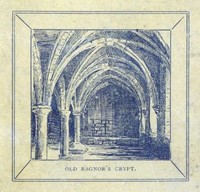
The excerpts repeatedly emphasize a treacherous coast: 'Old Ragnor's strand,' 'the beacon lamp,' 'the wreck of the Holy Cross.' The villain Sir Guy de Warre is compared to 'Ragnor's rocks' and swears Rowena would die rather than defy him. A 'demon wrecker' and 'smuggler's den' appear, along with 'Ragnor's dungeons grim' and a crypt. The setting is not merely decorative but drives the plot: the lamp of love is changed for one of hate, causing a shipwreck. The poem's language is often hyperbolic—'No Nero's lyre across his work of death such yells of triumph flung'—and relies on Gothic tropes of imprisonment, mistaken identity, and last-minute rescue.
The dedication thanks Queen Victoria for her 'unprecedentedly long, illustrious, and beneficent reign' and fifty years of service to National Education. This patriotic and religious framing continues in the poem: Rowena pleads that 'the heart belongs to God,' a holy friar offers consolation, and a character is 'crucified' (though not literally). The index includes 'Rowena's Te Deum' and 'The Royal Pardon,' suggesting a resolution involving monarchical mercy. The author's own note that he wrote in 'grateful remembrance' of the Queen places the work in a late-Victorian context of imperial and Christian piety, which the catalog subject does not capture.
Readers should approach this poem as a Victorian verse novel, not a lyric collection. The excerpts show a fast-paced plot with stock characters—the stern father, the faithful servant Eric, the Saracen helper—and a moral universe where divine and royal pardon converge. The catalog subject 'Poetry' is accurate but insufficient; the work is better understood as a melodramatic romance in rhyme, best enjoyed for its narrative energy and period flavor.
Some evenings, rereading Pryer’s verse, I’m struck by how its salt-worn cliffs hold the same quiet ache as Whittier’s New England shore—both poets knowing loss travels best in rhyme. That old, patient cadence stays with me. I found myself reaching for The Works of John Greenleaf Whittier, Complete — A Closer Reading, and the tide felt familiar.
A brief reflection can help important ideas stay with you longer.