About 236 minutes
The Lady of the Lake — Edition Insights
Fantasy Juvenile Worlds
54,152 recorded words. 38 minutes difference from this book's estimate.
View Gutenberg source #28287
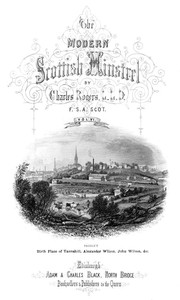
This digital edition of The Modern Scottish Minstrel, Volume 6. The Songs of Scotland of the Past Half Century — Themes and Context is described by source-level measurements including 63,010 words, 4 hr 34 min estimated reading time, and 12 detected text sections.
The text analysis averages about 18.0 words per sentence, while the detected sections provide another way to judge how the source is divided.
Project Gutenberg metadata also associates the work with “Scotland -- Poetry,” connecting these edition facts with the source record’s subject description.
Explore this collection
These alternatives are selected using recorded categories and estimated reading time.
About 236 minutes
Fantasy Juvenile Worlds
54,152 recorded words. 38 minutes difference from this book's estimate.
View Gutenberg source #28287About 361 minutes
Fantasy Juvenile Worlds
83,030 recorded words. 87 minutes difference from this book's estimate.
View Gutenberg source #9814About 176 minutes
Fantasy Juvenile Worlds
40,416 recorded words. 98 minutes difference from this book's estimate.
View Gutenberg source #8565Search stored excerpts and compare books → Choose by your preferences →
Choices use stored catalog measurements. Estimates vary with reading speed. A shared category is a catalog label, not a claim that two books have the same argument or literary quality.
Search reads excerpt text stored with this catalog and links to its associated Gutenberg record. The connection is stored in the site database; this tool does not recheck that every excerpt is word-for-word identical to that external record. Excerpt search does not cover every chapter and does not verify historical publication dates.
Catalog snapshot checked: 2026-09-26. Coverage: 99 public books, 99 available source excerpts.
Calculated from edition completeness, EPUB availability, text structure and catalogue metadata. Not a user rating.
Total of 100 points, scaled to a 2.5-5.0 range. Editions with an empty description or a missing EPUB file are not scored.
Public-domain source text
The source text is kept in the dedicated reader, separate from this catalogue record and its commentary.
Charles Rogers' sixth volume of The Modern Scottish Minstrel (1856) combines biographical memoirs with poetic specimens, aiming to represent Scottish song of the preceding half-century. The catalog subjects list Scotland, Scottish Gaelic poetry, and translations, yet the excerpts show that the bulk of the volume is in English or Scots, with only a few Gaelic pieces translated. The editor's dedication to Charles Baillie, convener of a committee for a national monument to William Wallace, signals a patriotic framing that recurs in poems like Charles Mackay's 'The Men of the North' and John Crawford's 'The Land o' the Bonnet and Plaid.'
Rogers prefaces each poet with a memoir that often emphasizes personal misfortune and rural inspiration. For instance, the entry on Thomas Elliott notes he 'followed an industrial occupation, but was unfortunate in business' and died at twenty-nine, leaving a widow and four children. The memoir of another poet describes how 'it was his delight to stray amidst rural scenes, and to imbibe inspiration among the solitudes of nature.' These details shape how the poems are read—as expressions of authentic feeling born from hardship. The biographies also record publication history, such as a thin 8vo volume of 'Literary Remains' issued for the poet's family benefit, grounding the anthology in a philanthropic impulse.
Several poems in the excerpts share a core imagery of the cold hearth and the lone figure. In 'The Lane Auld Man,' the speaker sits 'by the ingle cheek' whose 'hearth was cauld to his weary feet,' while 'The Wanderer's Return' finds 'cold is the hearth to the feet of the stranger.' Both poems mourn departed family—'ane by ane frae his side they pass'd'—and end with the grave. This pattern suggests a thematic preoccupation with isolation and memory, though the excerpts are too limited to confirm whether it pervades the entire volume. The poems also employ Scots dialect terms like 'weans' and 'gowans,' reinforcing a regional voice.
Several poems explicitly tie personal emotion to Scottish geography. 'The Wanderer's Return' names Lochwinnoch and describes 'the herd from the field to the fold' departing, while Charles Mackay's 'The Men of the North' (listed in contents) likely celebrates martial valor. John Crawford's 'The Land o' the Bonnet and Plaid' further links clothing and nation. However, the catalog subject 'Scottish Gaelic poetry' is barely represented in the excerpts—most poems are in English or Scots. The volume's subtitle promises 'Sketches and Specimens in English Verse of the Most Celebrated Modern Gaelic Bards,' but the provided text does not include such specimens, leaving the Gaelic component unverified from these excerpts.
Readers should approach this volume as a curated anthology where biographical context and poetic text are intertwined. The editor's choices—which poets to include, which poems to print, and how to frame their lives—reflect a mid-Victorian desire to preserve a national poetic heritage. The excerpts suggest a tension between the catalog's Gaelic emphasis and the actual predominance of English and Scots verse. To assess the volume's full scope, one would need to examine the Gaelic translations promised in the subtitle and the remaining contents not shown here.
Leafing through The Modern Scottish Minstrel, I paused on those poems of quiet loss and lonely hills, and somehow my thoughts drifted to a German volume sitting nearby. There’s a shared ache there, a same grey sky over different fields. I opened A Book of German Lyrics — Context and Discussion and felt that familiar twilight again, wordless recognition.
Use these questions to collect your thoughts before moving on.