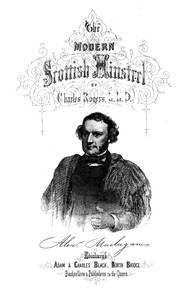
The Modern Scottish Minstrel, Volume 5. The Songs of Scotland of the Past Half Century — Reading Notes

(0 User reviews)   781
Rogers, Charles, 1825-1890 [Editor] Project Gutenberg 2007 Not confirmed
Scotland -- Poetry; Songs, Scottish Gaelic -- Texts; Scottish Gaelic poetry -- Translations into English Readers of public-domain and historical texts
Project Gutenberg digital edition en

Edition facts

Words 64,752
Reading time 282 min
Text sections 13

Before opening The Modern Scottish Minstrel, Volume 5. The Songs of Scotland of the Past Half Century — Reading Notes, the edition data offers a quick orientation: 64,752 words, 4 hr 42 min estimated reading time, and 13 detected text sections.

The text analysis averages about 24.4 words per sentence, while the detected sections provide another way to judge how the source is divided.

Project Gutenberg metadata also associates the work with “Scotland -- Poetry,” connecting these edition facts with the source record’s subject description.

Charles Rogers's fifth volume of 'The Modern Scottish Minstrel' presents lyrics and biographical memoirs of Scottish poets from the past half century, including Gaelic bards in translation. The opening essay by James Dodds argues for Scotland's lyrical abundance, while poems like Thomas Aird's 'The Swallow' and 'Genius' illustrate the collection's range from nature to philosophical verse.
Share
Editorial Edition Score 4.8/5

Calculated from edition completeness, EPUB availability, text structure and catalogue metadata. Not a user rating.

How this score is calculated
  • Description quality20 pts
  • Title & short description10 pts
  • Source metadata20 pts
  • Text length15 pts
  • Chapters / structure15 pts
  • EPUB file integrity20 pts

Total of 100 points, scaled to a 2.5-5.0 range. Editions with an empty description or a missing EPUB file are not scored.

Edition quality

Read the Text

t was there not something awanting to complete the unity of the scene? Where was the presiding divinity?

" ... _Deus_ nobis hæc otia fecit, Namque erit ille mihi semper deus."

Oh, for an hour past he has been watching the rustic carnival from yonder portico, with his gracious duchess (much his junior), his true help-meet in everything good, courteous, and benevolent! At length he descends into the circle, with a smile to all, a word of recognition to this one, a light airy jest at the expense of that one, and a responsive _hooch_ to the wild, whirling dancers. As he advances, all the pretty girls draw themselves up to catch his eye, and to have the honour of his hand in the dance. He strolls about, peering gently, until, in some obscure corner, he espies a young, shy, modest damsel, the lowliest there, whom no one is noticing, a lowly worker in the back kitchen, or even in the fields. Her he selects--blushing with surprise and a tumult of nameless emotions--to be Queen of the festival; he pats her on the shoulders, whispers paternal-gallant things in her ear, and calling lustily for "Tullochgorum" from the fiddlers, leads her gracefully through the dance, himself--though upwards of eighty--throwing some steps of the Highland Fling, snapping his fingers, and _hooching_ in unison with the impassioned throng of youths around him--those young stately plants who have grown up under the dew and shelter of his benign protection. When the dance is finished, kissing her on the cheek, he leads his little simple partner back to her seat, and leaves her in a delicious vision of the good old duke, who had distinguished her, sitting solitary and unnoticed, above all her companions, and placed the coronal upon her brow, queen of the festival. As he returns slowly to the castle, there is an involuntary pause in the merry-making. The musicians lay down their bows, the youths stop short in the mazes of the Bacchic dance, the spectators stand up uncovered, the subtle electric chain of love and loyalty passes between duke and people, and a grand universal "hurrah!" rings through the welkin--the outburst of gratitude, reverence, and joy. It is touching, solemn, sublime, this pause and outburst of feeling in the midst of the wild festal scene. Not a maiden there but loves him as she would a father; not a stalwart hind but, if need were, would die in defence of his old chief. "When the ear hears him, then it blesses him; and when the eye sees him, it gives witness to him; because he delivers the poor that cry, and the fatherless, and him that has none to help him. The blessing of him that is ready to perish comes upon him; and he causes the widow's heart to sing for joy. He puts on righteousness, and it clothes him; his judgment is as a robe and a diadem."

James Dodds's introductory essay, 'Scottish Lyrics and Scottish Life,' opens the volume with a bold claim: 'it may be doubted whether any country has equalled Scotland in the number of its lyrics.' He defines lyrics as 'poetical compositions, meant and suitable to be sung,' and immediately grounds his argument in the sheer volume of published collections and the ongoing recovery of songs from 'oral tradition in some out-of-the-way part of the country.' The essay sets a tone of national pride and scholarly care, emphasizing that the songs are not merely texts but living cultural artifacts.

The volume's structure—memoirs of poets followed by specimens of their work—is exemplified in the entry for Thomas Aird. Born in Roxburghshire in 1802, Aird studied at Edinburgh University, contributed to Blackwood's Magazine, and later edited the Dumfries Herald. His poems 'The Swallow' and 'Genius' show contrasting registers: one a lyrical nature piece, the other a philosophical meditation on creativity and history.

The Editor's Dedication and Purpose

Charles Rogers dedicates the volume to Alexander Baillie Cochrane, not for political alignment or patronage, but because Cochrane 'was one of the first of your order to join in the proposal of rearing a National Monument' to William Wallace and supported the Scottish Literary Institute, a society for 'the relief, in circumstances of virtuous indigence, of those men of genius and learning.' This dedication frames the anthology as both a patriotic and philanthropic endeavor. Rogers explicitly distances himself from political science, focusing instead on literary preservation and the support of poets. The dedication reveals the editor's dual aim: to celebrate Scottish song and to assist living writers in need.

James Dodds on the Abundance of Scottish Lyrics

In his essay, Dodds catalogs the vastness of Scottish song: 'The Scottish ballads are numerous, the Scottish songs all but numberless, and the Scottish tunes an inexhaustible fountain of melody.' He quotes a stanza—'And now 'twas like all instruments, / Now like a lonely flute'—to illustrate the music's range. Dodds notes that published collections are constantly supplemented by 'newly-discovered manuscript' or oral tradition, and that 'the numbers which have been preserved seem to be exceeded by the numbers that have unfortunately been lost.' He evokes the personal memory of 'the hum of many lyrics heard by him in his childhood —from mother, or nurse, or some old croon,' grounding his scholarly argument in lived experience.

Thomas Aird's Poetic Range: From Swallow to Genius

Aird's 'The Swallow' opens with a direct address: 'The little comer 's coming, the comer o'er the sea, / The comer of the summer.' The poem builds a domestic scene—'Oh, swallow by the lattice!'—and extends to the river that 'lapses through the valley' and the thunder-cloud that 'in deeper gloom is seen.' In contrast, 'Genius' adopts a philosophical voice: 'Eye of the brain and heart, O Genius, inner sight.' It traces the role of genius across history, from 'Lawgiver thine, and priest, and sage' to 'the classic Land' of 'Forum and amphitheatre.' The poem ends with a vision of 'Beauty thine, on loom divine, / Weaving the rainbow's woof of glory.' Together, the two poems demonstrate Aird's ability to move from intimate observation to grand historical reflection.

Gaelic Song and the Lament for a Lost World

The volume includes translations of Gaelic poetry, as seen in the excerpt beginning 'Och on a rie, &c.' The lines 'The hills that our brave fathers trod / Are now to the stranger a store' and 'The voice of the pipe and the bard / Shall awaken never more' express a clear note of loss. The speaker wishes 'I had less in this world to leave, / And be with them that are away.' This lament for a vanishing culture—where the land has passed to strangers and the bardic tradition is silenced—contrasts with Dodds's earlier optimism about the survival of songs. The juxtaposition suggests that the anthology is not merely a celebration but also an act of preservation against erasure.

Readers approaching this volume should attend to the interplay between the biographical memoirs and the poems themselves. The editor's choices—which poets to include, which verses to excerpt—reveal a deliberate shaping of a national literary canon. The Gaelic translations, in particular, offer a window into a tradition often marginalized in English-language collections. Rather than reading straight through, consider comparing the opening essay's claims about lyrical abundance with the actual poems, noting how each piece fits or challenges Dodds's framework.

I keep thinking about that old collection of Scottish songs, how each poet seemed to whisper their own private Scotland into being. That lingering feeling found me again in Ermeline — A Closer Reading, where every page feels like sitting with someone's careful, unhurried thoughts. It isn't loud or demanding. Just present, like a friend's quiet hand on your shoulder, long after you've put it down.

There are no reviews for this eBook.

0
0 out of 5 (0 User reviews )

Add a Review

Your Rating *
There are no comments for this eBook.

Reader reflection

What was your reading experience?

Capture what you thought, learned, and would like to remember.

Your progress 0 / 10
1

What is your current status with this title?

2

How did the book work for you overall?

3

Would you encourage someone else to read it?

4

How easy was the book to follow?

Related eBooks