About 25 minutes
Ermeline — A Closer Reading
Historical Psychological Social Fiction
5,584 recorded words. 1 minutes difference from this book's estimate.
View Gutenberg source #26791
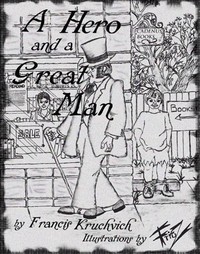
Before opening A Hero and a Great Man — Context and Discussion, the edition data offers a quick orientation: 5,968 words, 26 min estimated reading time, and 1 detected text section.
The text analysis averages about 15.1 words per sentence, while the detected sections provide another way to judge how the source is divided.
Project Gutenberg metadata also associates the work with “Poetry,” connecting these edition facts with the source record’s subject description.
Explore this collection
These alternatives are selected using recorded categories and estimated reading time.
About 25 minutes
Historical Psychological Social Fiction
5,584 recorded words. 1 minutes difference from this book's estimate.
View Gutenberg source #26791About 40 minutes
Historical Psychological Social Fiction
9,095 recorded words. 14 minutes difference from this book's estimate.
View Gutenberg source #14782About 41 minutes
Historical Psychological Social Fiction
9,330 recorded words. 15 minutes difference from this book's estimate.
View Gutenberg source #20909Search stored excerpts and compare books → Choose by your preferences →
Choices use stored catalog measurements. Estimates vary with reading speed. A shared category is a catalog label, not a claim that two books have the same argument or literary quality.
Search reads excerpt text stored with this catalog and links to its associated Gutenberg record. The connection is stored in the site database; this tool does not recheck that every excerpt is word-for-word identical to that external record. Excerpt search does not cover every chapter and does not verify historical publication dates.
Catalog snapshot checked: 2026-09-26. Coverage: 99 public books, 99 available source excerpts.
Calculated from edition completeness, EPUB availability, text structure and catalogue metadata. Not a user rating.
Total of 100 points, scaled to a 2.5-5.0 range. Editions with an empty description or a missing EPUB file are not scored.
Public-domain source text
The source text is kept in the dedicated reader, separate from this catalogue record and its commentary.
The story opens with an epigraph from Aesop—'We hang the petty thieves and appoint the great ones to public office'—immediately framing the work as a moral commentary on power and hypocrisy. The narrative unfolds in rhyming couplets and quatrains, following two contrasting figures: a 'great man' who 'feeds on attention' and a withdrawn 'freak' devoted to thought. The catalog lists this as 'Poetry; Stories in rhyme,' which accurately reflects its verse form, but the excerpts reveal a sustained philosophical dialogue about ambition, simplicity, and the nature of greatness, not merely a lighthearted tale.
The text is composed entirely in rhymed verse, with a consistent meter that gives the narrative a fable-like cadence. The great man is introduced through repetitive, almost incantatory lines: 'He likes to be seen. / He likes to be heard.' This structural choice reinforces his performative nature. In contrast, the 'freak' is described with more varied syntax and internal rhyme, such as 'His methods were strange and new. / A different world his eyes would see.' The rhyme scheme itself becomes a tool for character differentiation—the great man's sections feel predictable and self-satisfied, while the freak's passages allow for more irregular, thoughtful rhythms.
The narrative explicitly contrasts two models of greatness. The great man is defined by public recognition: 'He is well respected. / He enjoys much recognition. / He hopes to be selected / For a prestigious position.' His need for admiration is presented as a consuming drive: 'As greatness is a need / This need is his fate. / He is as great indeed, / As his need to feel great.' The freak, by contrast, values solitude and thought: 'He values his peace. / He is devoted to thought. / This is his release.' Yet the freak is also searching—'He never felt the peace / That he needed to feel'—suggesting that neither figure fully embodies an ideal.
A key episode involves two girls asking the great man, 'Where does the sun go at night?' He cannot answer and 'covertly looked about' for an escape. A passing stranger—the freak—offers an explanation, though the excerpt cuts before his answer is given. This unresolved question functions as a test of knowledge versus performance. The great man's reliance on 'delay' and evasion contrasts with the freak's willingness to engage. The girls later return to comfort the freak, calling the great man 'a great man indeed,' which the freak accepts. The ending leaves the reader to weigh whether the great man's public stature is earned or merely assumed.
Readers should attend to how the verse form shapes the moral argument: the great man's sections often use end-stopped lines and simple rhymes, while the freak's passages employ enjambment and more complex sound patterns. The epigraph from Aesop invites comparison to classical fables, but the work resists a tidy moral—the final line, 'He is a great man indeed,' is spoken by children, leaving its irony or sincerity open to interpretation.
Years among these shelves have taught me how ambition often shouts past the quiet hours that shape a soul. The verse-narrative's boasted hero finds his echo, or perhaps his answer, in Wordsworth's patient meditations—one clamors for the world's eye, the other learns to see without it. Both speak of what we choose to value, though only one invites us to sit a while and listen. The Poetical Works of William Wordsworth — Volume 3 (of 8) — A Closer Reading holds that quieter conversation, waiting for a reader who already understands.
Save your reaction, strongest insight, and memorable passage.