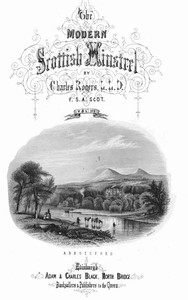
The Modern Scottish Minstrel, Volume 3. The Songs of Scotland of the Past Half Century — Text and Context

(0 User reviews)   149
Rogers, Charles, 1825-1890 [Editor] Project Gutenberg 2006 Not confirmed
Scotland -- Poetry; Songs, Scottish Gaelic -- Texts; Scottish Gaelic poetry -- Translations into English Readers of public-domain and historical texts
Project Gutenberg digital edition en

Edition facts

Words 65,816
Reading time 287 min
Text sections 12

This digital edition of The Modern Scottish Minstrel, Volume 3. The Songs of Scotland of the Past Half Century — Text and Context is described by source-level measurements including 65,816 words, 4 hr 47 min estimated reading time, and 12 detected text sections.

The text analysis averages about 22.3 words per sentence, while the detected sections provide another way to judge how the source is divided.

Project Gutenberg metadata also associates the work with “Scotland -- Poetry,” connecting these edition facts with the source record’s subject description.

This volume collects Scottish songs and poems from the mid-19th century, with biographical memoirs of poets and translations of Gaelic bards. The excerpts show varied diction—from Scots vernacular in love laments to formal English in a comparative essay on Hellenic and Scottish minstrelsy.
Share
Editorial Edition Score 4.8/5

Calculated from edition completeness, EPUB availability, text structure and catalogue metadata. Not a user rating.

How this score is calculated
  • Description quality20 pts
  • Title & short description10 pts
  • Source metadata20 pts
  • Text length15 pts
  • Chapters / structure15 pts
  • EPUB file integrity20 pts

Total of 100 points, scaled to a 2.5-5.0 range. Editions with an empty description or a missing EPUB file are not scored.

Edition quality

Read the Text

ere but the winter cauld, 12 It's hame, and it's hame, 13 The lovely lass of Inverness, 14 A wet sheet and a flowing sea, 15 The bonnie bark, 16 Thou hast sworn by thy God, my Jeanie, 17 Young Eliza, 19 Lovely woman, 20

EBENEZER PICKEN, 22 Peggie wi' the glancin' e'e, 24 Woo me again, 25

STUART LEWIS, 27 Lanark mills, 30 O'er the muir, 31

DAVID DRUMMOND, 34 The bonnie lass o' Levenside, 36

JAMES AFFLECK, 38 How blest were the days, 39

JAMES STIRRAT, 40 Henry, 41 Mary, 42

JOHN GRIEVE, 43 Culloden; or, Lochiel's Farewell, 46 Lovely Mary, 48 Her blue rollin' e'e, 48

CHARLES GRAY, 50 Maggie Lauder, 52 Charlie is my darling, 53 The black-e'ed lassie, 54 Grim winter was howlin', 55

JOHN FINLAY, 57 O! come with me, 59 'Tis not the rose upon the cheek, 60 I heard the evening linnet's voice, 61 Oh! dear were the joys, 62

WILLIAM NICHOLSON, 63 The braes of Galloway, 65 The hills of the Highlands, 66 The banks of Tarf, 67 O! will ye go to yon burn-side? 68

ALEXANDER RODGER, 71 Sweet Bet of Aberdeen, 73 Behave yoursel' before folk, 74 Lovely maiden, 76 The peasant's fireside, 78 Ah, no! I cannot say "Farewell," 79

JOHN WILSON, 81 Mary Gray's song, 86 The three seasons of love, 88 Prayer to Sleep, 90

DAVID WEBSTER, 91 Tak it, man; tak it, 92 Oh, sweet were the hours, 94 Pate Birnie, 95

WILLIAM PARK, 97 The patriot's song, 99

THOMAS PRINGLE, 102 Farewell to bonnie Teviotdale, 106 The exile's lament, 107 Love and solitude, 108 Come awa', come awa', 109 Dearest love, believe me, 110

WILLIAM KNOX, 112 The dear Land o' Cakes, 114 The lament, 116 To Mary, 116

WILLIAM THOM, 118 Jeanie's grave, 121 They speak o' wiles, 122 The mitherless bairn, 123 The lass o' Kintore, 124 My hameless ha', 125

WILLIAM GLEN, 126 Waes me for Prince Charlie! 128 Mary of sweet Aberfoyle, 129 The battle-song, 131 The maid of Oronsey, 134 Jess M'Lean, 136 How eerily, how drearily, 137 The battle of Vittoria, 139 Blink over the burn, sweet Betty, 140 Fareweel to Aberfoyle, 141

DAVID VEDDER, 143 Jeanie's welcome hame, 146 I neither got promise of siller, 147 There is a pang for every heart, 148 The first of May, 149 Song of the Scottish exile, 150 The tempest is raging, 151 The temple of nature, 152

JOHN M'DIARMID, 155 Nithside, 158 Evening, 159

PETER BUCHAN, 162 Thou gloomy Feberwar, 164

WILLIAM FINLAY, 166 The breaking heart, 167 The auld emigrant's fareweel to Scotland, 167 O'er mountain and valley, 169

JOHN GIBSON LOCKHART, 171 Broadswords of Scotland, 177 Captain Paton's lament, 178 Canadian boat-song, 183

THOMAS MATHERS, 184 Early love, 185

JAMES BROWN, 186 My Peggy's far away, 187 Love brought me a bough, 188 How 's a' wi' ye, 189 Oh! sair I feel the witching power, 192

DANIEL WEIR, 194 See the moon, 196 Love is timid, 196 Raven's stream, 197 Oh! our childhood's once delightful hours, 198 Could we but look beyond our sphere, 199 In the morning of life, 200 On the death of a promising child, 201 The dying hour, 202 The midnight wind, 203

ROBERT DAVIDSON, 206 Farewell to Caledonia, 207 On visiting the scenes of early days, 208 To wander lang in foreign lands, 210

PETER ROGER, 212 Lovely Jean, 214

JOHN MALCOLM, 215 The music of the night, 217 The sea, 218

ERSKINE CONOLLY, 220 Mary Macneil, 221 There 's a thrill of emotion, 222

GEORGE MENZIES, 223 The braes of Auchinblae, 224 Fare thee weel, 225

JOHN SIM, 226 Nae mair we 'll meet, 227 Bonnie Peggy, 227 Now, Mary, now the struggle 's o'er, 229

WILLIAM MOTHERWELL, 230 Jeanie Morrison, 233 Wearie's Well, 236 Wae be to the orders, 238 The midnight wind, 239 He is gone! he is gone! 240

DAVID MACBETH MOIR, 242 Casa Wappy, 245 Farewell, our fathers' land, 249 Heigh ho, 250

ROBERT FRASER, 252 Oh, I lo'ed my lassie weel, 253

JAMES HISLOP, 254 The Cameronian's dream, 257 How sweet the dewy bell is spread, 259

ROBERT GILFILLAN, 261 Manor braes, 262 Fare thee well, 263 The first rose of summer, 264 The exile's song, 264 The happy days o' youth, 266 'Tis sair to dream, 267

METRICAL TRANSLATIONS FROM THE MODERN GAELIC MINSTRELSY.

WILLIAM ROSS, 271 The Highland May, 272 The Celt and the stranger, 274 Cormac's cure, 274 The last lay of love, 276

LACHLAN MACVURICH, 279 The exile of Cluny, 280

JAMES M'LAGGAN, 282 Song of the royal Highland regiment, 284

MODERN SCOTTISH MINSTREL.

The third volume of Charles Rogers's anthology opens with an essay that compares Scottish and Hellenic lyric poetry, arguing that cross-cultural comparison widens the heart and reveals both excellences and deficiencies. The editor's prefatory materials—a dedication to a military officer and a lithographed portrait of Allan Cunningham—signal the work's dual aim: to preserve national song and to situate it within a broader literary tradition. The excerpts that follow range from Scots dialect love songs to a ballad about the Battle of Vittoria, illustrating the variety of voices Rogers assembled.

Diction and Dialect in the Songs

The songs in this volume employ a deliberate contrast between Scots vernacular and standard English. In “How eerily, how drearily,” the speaker uses Scots forms like thae, frae, ilka ee, and wastlin win's, grounding the lament in a specific regional voice. The refrain “blaw wi' a steady breeze” echoes oral tradition. By contrast, “Jess M'Lean” is written in a more polished English, with phrases like “Her auburn hair was waving / In ringlets on the gale” and the conceit of bones turned to coral. This shift suggests that the editor valued both the immediacy of dialect and the accessibility of standard verse.

Recurring Motifs of Separation and the Sea

Several poems share a preoccupation with distance and the sea as a barrier. In “Oronsey,” the speaker addresses a bird, asking it to fly “across the roaring deep” to a faithless maiden. “How eerily, how drearily” yearns for a lover “far across the sea,” while “Jess M'Lean” ends with the drowned woman transformed into coral and pearl beneath the waves. The sea functions both as a literal obstacle and as a site of transformation—loss becomes permanence through imagery of the beloved turned to ocean treasures. This motif recurs across different authors, suggesting a collective poetic vocabulary.

The Editor's Comparative Framework

Rogers includes an essay by James Donaldson that explicitly compares Scottish and Greek lyric poetry. Donaldson warns that judging one's own tradition in isolation breeds conceit, and advocates for a wider survey that “expands the nature.” He traces Greek lyric from the eighth century BCE through the Athenian stage, naming poets such as Anacreon, Sappho, and Pindar. The essay positions Scottish song within a classical lineage, implying that the vernacular poems that follow are not merely local curiosities but part of a universal lyric impulse. This framing shapes how the reader encounters the Scots ballads—as artifacts worthy of serious comparative study.

Narrative Compression in the Ballads

The ballads in this volume often compress a full story into a few stanzas. “Jess M'Lean” moves from weeping to drowning to posthumous transformation in eight quatrains, each stanza advancing the plot with a clear image: the picture clasp snapped by a blast, the leap into the billows, the coral bones. Similarly, “The Battle of Vittoria” uses a brisk tune and repeated exclamations (“Sing a' ye bards”) to celebrate a military victory without detailed battle description. This economy of narrative suggests the songs were designed for oral performance, where a single striking image—like the “spirit of the ocean” sitting on the shore—must carry emotional weight.

Readers approaching this volume should attend to the interplay between the editor's scholarly apparatus and the poems themselves. The biographical memoirs and comparative essay provide context, but the songs reward close attention to their linguistic choices—why one poet uses Scots and another English, or how a refrain shapes the mood. The volume is best read as a curated collection that reveals the range of 19th-century Scottish song, from domestic lament to martial ode, each with its own formal logic.

That rainy afternoon, the Minstrel’s Gaelic laments lingered longer than its formal essays, their raw ache against clipped drawing-room verses. I wanted that roughness, that unvarnished pulse, and my hand drifted to an older, bawdier shelf. It’s why I ended up with Thomas Nashe’s scandalous poem, The Choise of Valentines; Or the Merie Ballad of Nash His Dildo — A Closer Reading, a different kind of honest, blunt heartbeat entirely.

There are no reviews for this eBook.

0
0 out of 5 (0 User reviews )

Add a Review

Your Rating *
There are no comments for this eBook.

Reader reflection

Take a moment to reflect on this book

Create a short personal record of your experience with this book.

Your progress 0 / 10
1

Where are you in your reading?

2

Was reading this book enjoyable?

3

How likely are you to recommend this book?

4

Did the language feel accessible?

Related eBooks