About 163 minutes
Songs from Books — Story, Setting & Ideas
Science Fiction Utopias
37,293 recorded words. 3 minutes difference from this book's estimate.
View Gutenberg source #15529
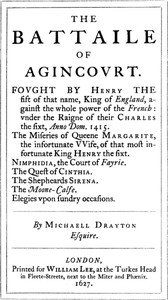
The source record for The Battaile of Agincourt — Edition Insights measures this digital text at 36,602 words, 2 hr 40 min estimated reading time, and 8 detected text sections.
The text analysis averages about 30.5 words per sentence, while the detected sections provide another way to judge how the source is divided.
Project Gutenberg metadata also associates the work with “Agincourt, Battle of, Agincourt, France, 1415 -- Poetry,” connecting these edition facts with the source record’s subject description.
Explore this collection
These alternatives are selected using recorded categories and estimated reading time.
About 163 minutes
Science Fiction Utopias
37,293 recorded words. 3 minutes difference from this book's estimate.
View Gutenberg source #15529About 142 minutes
Science Fiction Utopias
32,508 recorded words. 18 minutes difference from this book's estimate.
View Gutenberg source #9606About 139 minutes
Science Fiction Utopias
31,866 recorded words. 21 minutes difference from this book's estimate.
View Gutenberg source #21890Search stored excerpts and compare books → Choose by your preferences →
Choices use stored catalog measurements. Estimates vary with reading speed. A shared category is a catalog label, not a claim that two books have the same argument or literary quality.
Search reads excerpt text stored with this catalog and links to its associated Gutenberg record. The connection is stored in the site database; this tool does not recheck that every excerpt is word-for-word identical to that external record. Excerpt search does not cover every chapter and does not verify historical publication dates.
Catalog snapshot checked: 2026-09-26. Coverage: 99 public books, 99 available source excerpts.
Calculated from edition completeness, EPUB availability, text structure and catalogue metadata. Not a user rating.
Total of 100 points, scaled to a 2.5-5.0 range. Editions with an empty description or a missing EPUB file are not scored.
Public-domain source text
The source text is kept in the dedicated reader, separate from this catalogue record and its commentary.
Michael Drayton's The Battaile of Agincourt (1627) is presented here in a 1893 edition edited by Richard Garnett, with an introduction that situates the poem within the context of English national epic writing. The text retains original spelling conventions—'Fift' for 'Fifth', and the use of 'v' initially and 'u' medially—which may require some adjustment from modern readers. The poem itself employs vivid similes, such as comparing the French charge to a tidal wave 'at the full Moone' against a cliff, and describes the English archers' arrows striking French horses 'like cruell Hornets'. Garnett's introduction argues that the age's dramatic genius overshadowed epic poetry, yet Drayton's work stands as a deliberate literary effort to render history in verse.
Garnett's introduction places Drayton's poem in a European tradition of national epics, citing Spanish and Portuguese examples like the Lusiad. He notes that England's epic impulse was diverted by the flourishing drama of Shakespeare and Marlowe, whose historical plays 'turned the dross of ancient chronicles to gold'. This framing suggests that Drayton's poem is a conscious literary artifact rather than a spontaneous ballad, aiming to 'present history in an epic form'. The editor's perspective is evident in his choice to include commendatory verses by I. Vaughan, John Reynolds, and Ben Jonson, which further emphasize the work's literary aspirations.
The excerpted battle sequence demonstrates Drayton's use of simile and sensory detail. The French charge is likened to an 'vnweldy Tide' foaming against a 'ragged Cliffe', while the English archers' arrows are compared to 'cruell Hornets' stinging the horses' flanks. The poem also includes specific tactical elements: Sir Thomas Erpingham gives the signal by 'Wafting his Warder thrice about his head', and the English kneel in prayer before rising 'Actiue as fire'. The description of horses 'tumbling on heapes' with 'foure feete all vp into the ayre' creates a chaotic, visceral scene. Drayton's consistent use of archaic spelling—such as 'showt' for 'shout' and 'stong' for 'stung'—adds a period flavor but may slow modern reading.
This edition reproduces the original spelling, including the consistent use of 'Fift' and the v/u convention. Typographical errors are indicated with mouse-hover popups, and the editor notes exceptions to the spelling rules. The text also includes links to Garnett's 'Illustrative Notes', which provide historical context. Readers should be aware that the poem's language, while accessible, contains archaic vocabulary and syntax—for example, 'nayde' for 'neighed' and 'Iades' for 'jades' (horses). The introduction's scholarly tone contrasts with the poem's martial energy, offering a dual perspective: the editor's analytical view and Drayton's immersive battle narrative.
For readers approaching this work, it may be helpful to read Garnett's introduction first, as it clarifies the poem's literary ambitions and historical context. The illustrative notes at the end provide glosses on specific references. Given the archaic spelling, reading aloud or following with a modernized text could aid comprehension. The poem rewards attention to its similes and battle choreography, which are more detailed than in many contemporary accounts.
That rainy afternoon, Drayton’s tidal wave of French cavalry kept washing over my mind’s eye, yet Garnett’s careful notes felt like shelter. When the storm finally softened, I reached for something quieter, and found myself snowed in with a different kind of stillness. Snow-Bound A Winter Idyll — Reading Notes held the same patient hush, a warmth against the cold outside my own window.
Use these questions to collect your thoughts before moving on.