
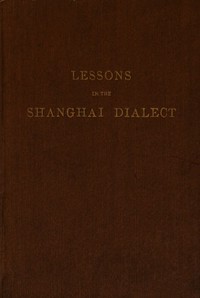
Lessons in the Shanghai Dialect by F. L. Hawks Pott
Published in 1907, Lessons in the Shanghai Dialect is exactly what its title promises: a textbook. But to dismiss it as just that would be a huge mistake. Francis Lister Hawks Pott, a long-term American missionary and educator in Shanghai, created this guide to help fellow Western residents navigate the city not just geographically, but socially. The book is structured with English phrases on one side and their Romanized Shanghai dialect equivalents on the other.
The Story
There's no traditional narrative. Instead, the "story" unfolds through the carefully chosen phrases. We move from simple greetings and numbers to complex, situation-specific dialogues. We learn how to hire a boat, complain about prices at the market, give orders to household staff, and discuss the weather. Each chapter builds a picture of the foreigner's daily orbit in early 20th-century Shanghai. The progression from basic vocabulary to these detailed scripts tells its own tale—one of increasing, but always careful, engagement with a complex local society.
Why You Should Read It
This book fascinated me because it's an artifact of cultural collision. Pott wasn't just teaching words; he was teaching how to be. The phrases reveal the assumptions, anxieties, and power dynamics of the time. The need to learn how to say "Don't be dirty" or "You are cheating me" speaks volumes. Yet, there's also a clear respect for the language and a genuine desire for practical communication. Reading it, I felt like I was overhearing the foundational conversations of an international city being built, one awkward exchange at a time. It makes history feel immediate and personal.
Final Verdict
This is a niche read, but a rewarding one. It's perfect for language nerds, history lovers, and anyone obsessed with Shanghai's past. Don't expect a sweeping historical drama. Instead, get ready for a slow, close-up look at the gritty mechanics of cross-cultural life. If you enjoy primary sources that let you read between the lines, you'll find this old textbook surprisingly full of life, conflict, and human connection.
You are viewing a work that belongs to the global public domain. Access is open to everyone around the world.
Emily Johnson
4 months agoI took detailed notes while reading through the chapters and the author’s unique perspective adds a fresh layer to the discussion. I am looking forward to the author's next publication.
Kenneth Harris
10 months agoThe layout is very easy on the eyes.
Lucas Lee
8 months agoGreat read!
Jennifer Taylor
2 years agoJust what I was looking for.






Thomas Rodriguez
11 months agoInitially, I was looking for a specific answer, but the level of detail in the second half of the book is truly impressive. An excellent example of how quality digital books should be formatted.