About 41 minutes
Under the Tree — Key Ideas to Explore
Historical Psychological Social Fiction
9,330 recorded words. 1 minutes difference from this book's estimate.
View Gutenberg source #20909
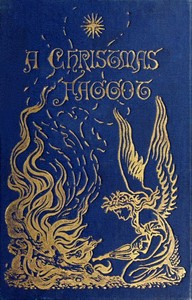
A Christmas Faggot — Edition Insights can be approached with a clearer sense of reading commitment from its source measurements: 9,529 words, 42 min estimated reading time, and 2 detected text sections.
The text analysis averages about 23.2 words per sentence, while the detected sections provide another way to judge how the source is divided.
Project Gutenberg metadata also associates the work with “Christian poetry,” connecting these edition facts with the source record’s subject description.
Explore this collection
These alternatives are selected using recorded categories and estimated reading time.
About 41 minutes
Historical Psychological Social Fiction
9,330 recorded words. 1 minutes difference from this book's estimate.
View Gutenberg source #20909About 40 minutes
Historical Psychological Social Fiction
9,095 recorded words. 2 minutes difference from this book's estimate.
View Gutenberg source #14782About 47 minutes
Historical Psychological Social Fiction
10,760 recorded words. 5 minutes difference from this book's estimate.
View Gutenberg source #17779Search stored excerpts and compare books → Choose by your preferences →
Choices use stored catalog measurements. Estimates vary with reading speed. A shared category is a catalog label, not a claim that two books have the same argument or literary quality.
Search reads excerpt text stored with this catalog and links to its associated Gutenberg record. The connection is stored in the site database; this tool does not recheck that every excerpt is word-for-word identical to that external record. Excerpt search does not cover every chapter and does not verify historical publication dates.
Catalog snapshot checked: 2026-09-26. Coverage: 99 public books, 99 available source excerpts.
Calculated from edition completeness, EPUB availability, text structure and catalogue metadata. Not a user rating.
Total of 100 points, scaled to a 2.5-5.0 range. Editions with an empty description or a missing EPUB file are not scored.
Public-domain source text
The source text is kept in the dedicated reader, separate from this catalogue record and its commentary.
Alfred Gurney's A Christmas Faggot (1884) opens with a dedication in verse to his godchildren, inviting them to 'trace life's lovely river / To the Fountain-head' after passing through baptismal waters. The collection's title—a 'little bundle of sticks' to feed the fires of the King's winter palace—announces its modest, occasional character. Most poems first appeared in a parish magazine, and the preface insists that 'the Incarnation that justifies all joy, and song is the expression of joy.' The opening poem, 'Yule Tide,' immediately establishes a tonal paradox: 'They bring me sorrow touched with joy, / The merry merry bells of Yule.' This tension between mourning and celebration recurs throughout, as the speaker acknowledges that love is 'too humble to despair, / Too faithful to forget.'
The book's paratexts do more than introduce; they enact the collection's central gesture of offering. The dedication poem, addressed to eight named godchildren, uses the image of an angel stirring 'the wave baptismal' to connect their baptism to the Incarnation. The preface, written from Loch Leven, describes the poems as 'a Christmas faggot to feed the fires in the winter palace of our King.' This domestic, liturgical framing is reinforced by the epigraph from Herrick, which speaks of giving the heart as a 'roome' for Christ, adorned with 'hollie and this ivie wreath.'
'Yule Tide' then introduces the collection's emotional register: the speaker is a 'vassal' of Love, who 'sings to-day' with 'happy tears.' The poem moves from general statements about sufferers forgetting pain to a personal desire to 'repeat / Some fragments of her song.' This self-positioning as a humble transmitter, not an original creator, recurs in later poems and notes.
Several poems respond directly to visual art. 'The Madonna Di San Sisto' engages Raphael's famous painting, and the accompanying note quotes Canon Westcott on how the image 'constrains the beholder to look beyond.' Gurney's poem likely renders the 'tremulous fulness of emotion' and 'intense, far-reaching gaze' that Westcott describes. Similarly, 'Bethlehem Gate' is glossed by an unpublished note on a Rossetti picture, which interprets the scene as 'the Church's pilgrimage through the world.' The note explains that the massacre of innocents represents 'the world, in whose cruel habitations the same outrage is ever being enacted,' while the Holy Family passes through the gate toward Egypt, which 'beneath her feet becomes the holy land.'
These ekphrastic poems do not merely describe; they use the paintings as springboards for theological meditation. The notes, drawn from contemporary critics, suggest Gurney saw art as 'a revelation from heaven, and a mighty power for God,' capable of 'bringing out things in God which lie too deep for words.'
The collection's contents page reveals a deliberate liturgical architecture. After poems on the Nativity—'Bethlehem Gate,' 'Saint Joseph,' 'A Cradle Song,' 'An Empty Cradle'—the sequence moves through 'New Year's Eve,' 'The Victim,' 'The Daysman,' and 'The Physician,' before culminating in 'The Gospel Songs': the Benedictus, Magnificat, and Nunc Dimittis. These canticles, drawn from the Gospel of Luke, are central to Christian daily prayer. By placing them at the end, Gurney frames the entire collection as a preparation for or echo of liturgical praise.
The note on 'The Daysman' (a term for mediator) emphasizes that 'the Word became Flesh and tabernacled among us' is 'the supreme and august Verity.' For Gurney, the Scripture-record is alive because readers discern 'not certain words about Christ, but Christ the Word Himself.' This incarnational theology underpins the collection's movement from Christmas joy to the passion and beyond.
The endnotes are not afterthoughts but integral to the reading experience. They provide sources, theological context, and critical endorsements. For 'The Madonna Di San Sisto,' Gurney quotes Mrs. Jameson's description of the Virgin as 'the transfigured woman—at once completely human and completely divine,' and Canon Westcott's argument that the painting reveals 'a fellowship of earth with heaven.' These quotations do not simply validate Gurney's interpretation; they model a way of seeing that the poems themselves enact.
The note on 'Bethlehem Gate' is especially revealing: it is drawn from 'some unpublished notes on the pictures by Rossetti,' suggesting Gurney moved in circles where art and theology were closely intertwined. The note interprets the picture as an allegory of the Church's pilgrimage, with the Holy Family as 'the infant Church.' This typological reading—where biblical figures prefigure ecclesial realities—is characteristic of the collection's method.
Reading A Christmas Faggot from beginning to end reveals a carefully ordered devotional sequence, not a random gathering of occasional verses. The poems gain resonance when read alongside their prose notes, which supply the theological and artistic contexts that Gurney assumed his original audience shared. A first-time reader may wish to treat the notes as companion pieces rather than appendices, moving between poem and annotation to trace how the Victorian Anglican imagination wove together scripture, liturgy, and visual art into a single 'bundle of sticks' meant to kindle love.
There’s something tender about Gurney gathering those verses for his godchildren, sorrow brushed with hope. It makes me think of another quiet kind of memorial, A Hero and a Great Man — Context and Discussion. Both seem to hold a person close, not to explain them, but simply to keep their warmth near the hearth a little longer.
A brief reflection can help important ideas stay with you longer.