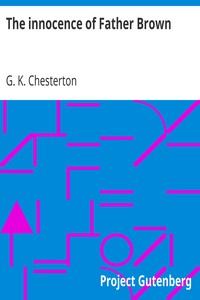
The innocence of Father Brown by G. K. Chesterton
Forget everything you think you know about detective stories. The Innocence of Father Brown isn't about a brilliant outsider solving crimes for a baffled police force. It's about a quiet, unassuming Catholic priest who stumbles into mysteries because he's simply there, listening and observing.
The Story
The book is a collection of twelve short stories. In each one, Father Brown, often accompanied by his friend the reformed criminal Flambeau, encounters a bizarre and seemingly supernatural crime. A priceless silver cross is stolen from a sealed room. An inventor is found dead in a field with no footprints around him. A man is beheaded in a locked library. The solutions are never about secret passages or complex gadgets. Father Brown solves them by understanding why people do what they do. He gets inside the criminal's mind, not through profiling, but through a profound, almost spiritual, grasp of human nature.
Why You Should Read It
What makes this book so special is Father Brown himself. He's the opposite of Sherlock Holmes. He's clumsy, forgetful, and looks utterly harmless. His power comes from his humanity. He can solve the crime because he believes he could have committed it himself—he understands the temptation. Chesterton uses these clever plots to talk about bigger ideas: how we mistake appearance for reality, why we create myths to explain our sins, and where true innocence actually lies. The stories are quick, satisfying reads, but they stick with you because of their heart and their quiet wisdom.
Final Verdict
This is the perfect book for anyone who loves a good mystery but is looking for something with more soul. It's for readers who enjoy classic Agatha Christie puzzles but want a detective with a different kind of depth. If you like stories where the solution makes you think, "Oh, of course!" not just about the clues, but about people, you'll love Father Brown. It's a timeless, charming, and genuinely clever collection that proves the best detectives don't need a magnifying glass—they need empathy.
This is a copyright-free edition. Thank you for supporting open literature.
Mary Lopez
2 years agoThis digital copy caught my eye due to its reputation, the historical context mentioned in the early chapters is quite enlightening. I feel much more confident in my knowledge after finishing this.
Jennifer Garcia
5 months agoInitially, I was looking for a specific answer, but the structural organization allows for quick referencing of key points. Simple, effective, and authoritative – what else could you ask for?
Patricia Brown
1 year agoHaving explored several resources on this, I find that the formatting on mobile devices is surprisingly crisp and clear. It’s a comprehensive resource that doesn't feel bloated.
Ashley White
2 years agoBefore I started my latest project, I read this and the critical analysis of current industry standards is very timely. An excellent example of how quality digital books should be formatted.

Karen Johnson
4 months agoMy first impression was quite positive because the transition between theoretical knowledge and practical application is seamless. A mandatory read for anyone in this industry.