
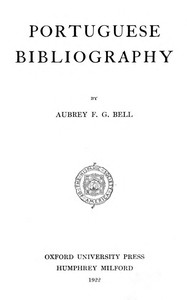
Portuguese bibliography by Aubrey F. G. Bell
Let's be clear from the start: this isn't a novel. You won't find a plot with heroes and villains. But it absolutely has a story. Aubrey Bell, an Englishman who fell in love with Portugal, made it his life's work to track down and catalog the nation's written word. 'Portuguese Bibliography' is the result of that obsession. It's a detailed guide, organized by author and subject, that tries to account for the vast landscape of Portuguese writing up to his time.
The Story
The 'story' is Bell's journey. Picture him traveling by train and carriage to remote convents, negotiating with private collectors, and spending hours in dimly lit archives. Each entry in this bibliography represents a physical book he likely held, a puzzle piece he fitted into place. He wasn't just listing names; he was recovering identities for authors and works that Europe had largely overlooked. The narrative is the slow, meticulous building of a monument made of paper and ink, proof against cultural amnesia.
Why You Should Read It
You should read it for the passion. Bell's voice shines through the formal structure. His notes often reveal his excitement over a rare find or his frustration with a missing volume. It makes you appreciate the sheer labor of love behind scholarship. This book opens a door. If you've ever enjoyed the poetry of Camões or the novels of Eça de Queirós, this shows you the deep and wide ocean they swam in. It turns a single country's literature from a vague concept into a tangible, crowded, and vibrant world.
Final Verdict
This is a niche read, but a rewarding one. It's perfect for history buffs with a soft spot for books-as-objects, for anyone tracing Portuguese or Lusophone roots, or for bibliophiles who love stories about the hunt for rare books. It's also a fascinating resource for writers and scholars looking for forgotten paths in literary history. Don't read it cover-to-cover like a novel. Dip into it. Explore a century or a topic. Let Bell be your guide to a library that spans a whole nation. You'll come away with a new respect for the quiet, determined work that preserves our stories.
This historical work is free of copyright protections. It serves as a testament to our shared literary heritage.
William Johnson
2 years agoWhile browsing through various academic sources, the narrative arc keeps the reader engaged while delivering factual content. Truly a masterpiece of digital educational material.
Donald Anderson
8 months agoThe digital formatting makes it very easy to navigate.
Nancy White
1 year agoThe analytical framework presented is both innovative and robust.
Barbara Rodriguez
8 months agoI was skeptical about the depth of this book at first, but the cross-referencing of different chapters makes it a great study tool. Thanks for making such a high-quality version available.





Patricia Rodriguez
2 months agoRight from the opening paragraph, it addresses the common misconceptions in a very professional manner. The insights gained here are worth every minute of reading.